TORQUE CONVERTER CLUTCH (TCC) CONTROL, SLIP CONTROL
Outline
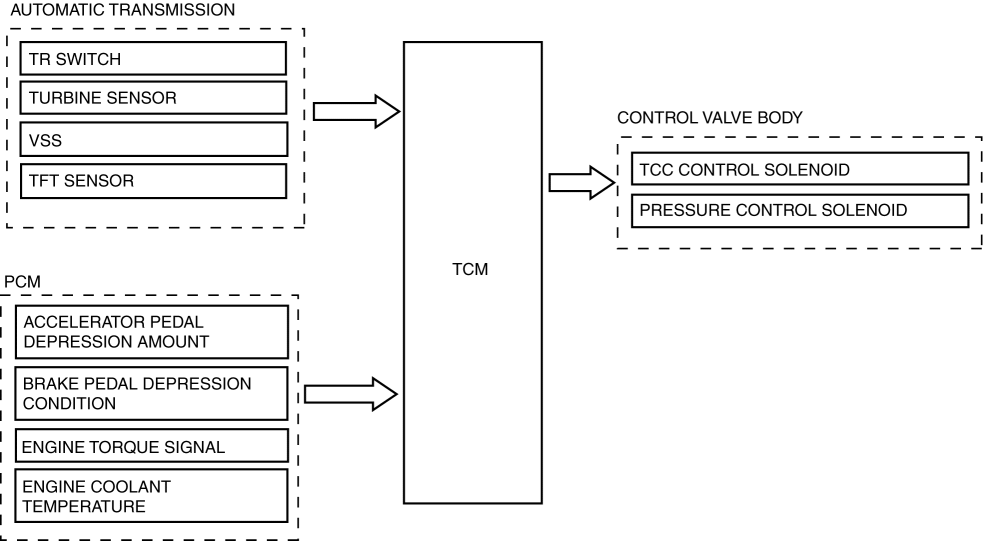
Based on output speed signals, signals from the PCM (engine speed and accelerator pedal depressing amount) and vehicle speed, smooth TCC control is achieved through linear control of the TCC control solenoid. In addition, the slip rate is detected and slip control is achieved by adding input rpm signals.
TCC control
Control is performed using a TCC control solenoid. The TCC control solenoid is linearly turned ON and OFF, the TCC clutch inside the torque converter is operated, and the pump impeller and turbine runner are connected. This enables coupling of the engine and the automatic transmission. Engine output is connected directly to the automatic transmission, eliminating transmission loss and enhancing fuel economy.
Slip control
Control is performed using a TCC control solenoid. The TCC control solenoid is linearly turned ON and OFF and the TCC piston within the torque converter is operated outside of the TCC range. The TCC piston slides without being in a completely coupled condition, increasing transmission efficiency and enhancing fuel economy.
Construction
Block diagram
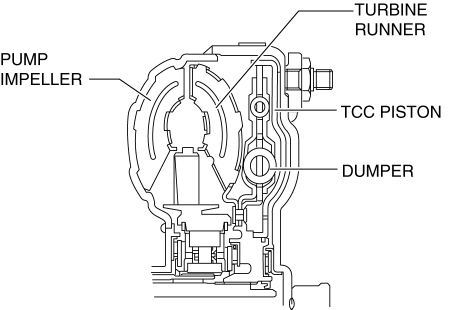
The TCC mechanism consists of a TCC piston, and a damper which are installed inside the torque converter.
Operation
TCC control
TCC engagement
A current signal is sent from the TCM to the TCC control solenoid during TCC engagement. At the same time, the TCC piston engagement pressure is gradually increased.
As a result, the TCC piston is pressure-bonded to the TCC clutch slowly to perform smooth TCC engagement.
TCC release
A current signal is sent from the TCM to the TCC control solenoid during TCC release. At the same time, the TCC piston engagement pressure is gradually drained.
As a result, the TCC piston releases the TCC clutch slowly to release the TCC smoothly.
Slip control
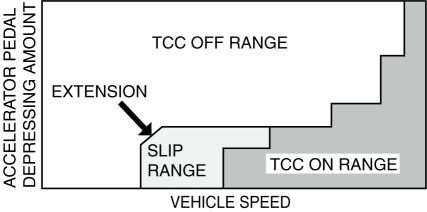
By sliding the TCC piston when TCC is in the OFF range, slip control extends the TCC range to low vehicle speeds. This suppresses a rise in engine speed and increases transmission efficiency, improving fuel economy. At the same time, through the sliding of the TCC piston, engine vibration can be absorbed by the torque converter.
< Previous Next >Inhibition of TCC control
If any one of the following conditions is met, the torque converter clutch control is inhibited.
TCC solenoid malfunction
ATF temperature is specified value or less
Output shaft speed is specified value or less
Other than D/M position